
Uber’s IPO prices shares at $45, hinting at a potential path to long-term gains.
During its public debut, Uber raised billions, boosting its market cap to $82 billion despite a nearly 30% drop in early trading.
Investors see the pricing as a smart move that builds trust, even amid short-term jitters and ongoing driver protests.
This cautious approach raises the question: Can Uber transform early volatility into lasting growth?
Uber IPO Pricing Sparks Investor Optimism
Uber set its public debut at $45 per share, raising $8.1 billion and landing at an $82.4 billion market valuation. The offering hit the low end of its anticipated $44–$50 range as a way to boost capital while exercising caution amid ongoing global driver protests.
Despite securing billions in capital, debut trading slid nearly 30% in one day. That decline surprised many since the strong capital raise and solid valuation pointed to long-term potential rather than immediate gains.
Investors, however, are watching cautiously. They see the drop as a market adjustment on Day 1, not a sign of weakness in Uber’s business. The coming sessions will show whether trading steadies and if Uber can balance short-term volatility with growth in the competitive ridesharing market.
Underwriter Strategy and Valuation Methodology in Uber IPO Pricing

Underwriters balanced Uber's fast growth story with its uneven profits. They set the IPO price at $45, at the low end of a $44–$50 range. They based this decision on 2018 figures, $11.27 billion in revenue, $997 million in net income, and an adjusted EBITDA loss of $1.85 billion, along with roadshow demand estimates. This mix of strong revenue and operating challenges led to a careful, balanced valuation.
Key Valuation Inputs
Underwriters built their model on recent revenue trends and profitability metrics. They examined performance data from 2016 through 2018, noting Uber's expanding business model and market reach. They also compared Uber with other rideshare companies to capture both its growth potential and the risks in its operating metrics.
Pricing Range Decisions and Allocation
The chosen range, $44–$50, reflected a balance between optimistic growth outlooks and caution over mixed profitability. Pricing at $45 allowed underwriters to stay competitive while strategically dividing shares between institutional and retail investors. This approach aimed to manage market expectations and set the stage for a stable public launch.
Investor Sentiment and Regulatory Disclosures in Uber IPO Pricing
The SEC prospectus showed that Uber's ridesharing business grew quickly. Revenues climbed from $3.5B in 2016 to $9.2B in 2018, with gross bookings hitting $41.5B. This strong growth caught investor attention amid a period of rapid scaling and operational challenges.
The prospectus also revealed 2018 numbers: total revenues of $11.27B, net income of $997M, and an adjusted EBITDA loss of $1.85B. Underwriters used these figures to balance the outlook for expansion with concerns over profitability. The IPO came at a time when global driver protests, including a major strike in San Francisco, kept investor caution high.
Meanwhile, Lyft’s 2018 performance, with revenues of $2.1B, roughly $1B in losses, and $8.1B in bookings, set a useful benchmark. Uber’s mix of growth and regulatory details played a key role in shaping its IPO pricing strategy.
First-Day Trading Statistics and Benchmark Analysis of Uber IPO Pricing
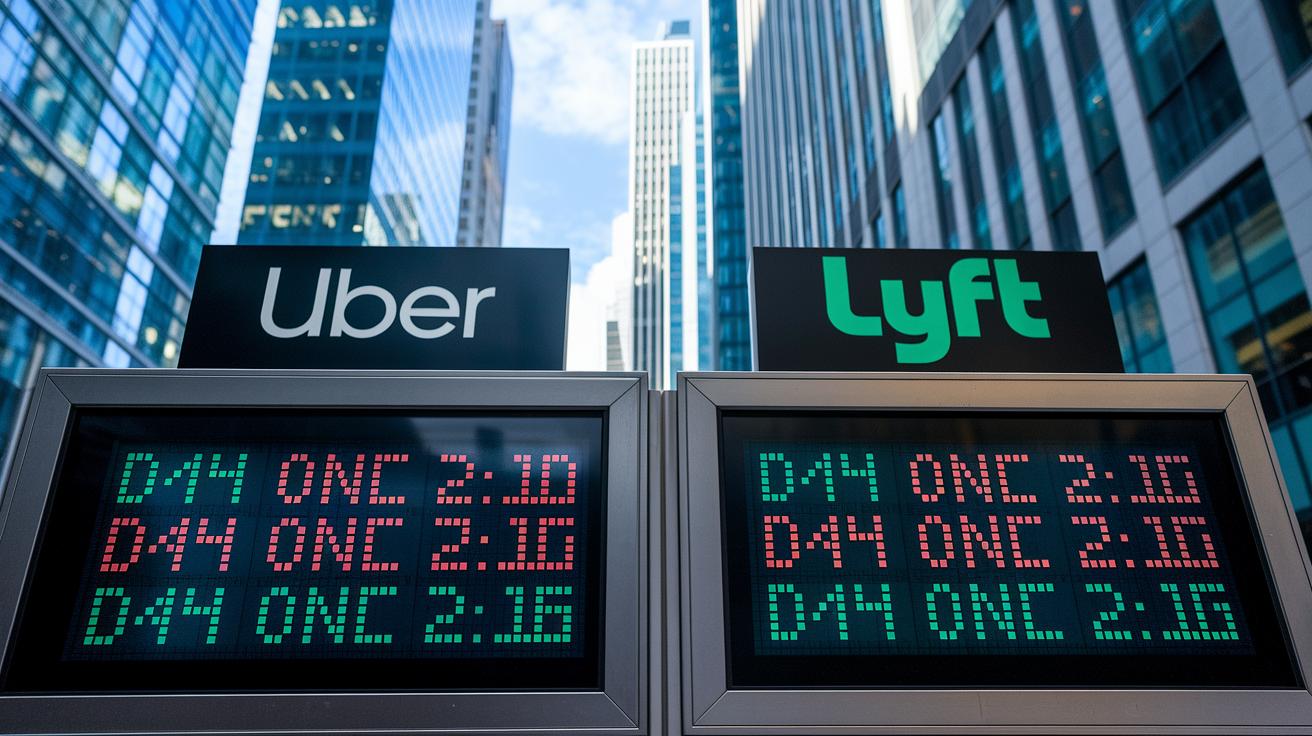
Uber shares opened at $45 on its debut day but closed nearly 30% lower, sparking concerns among investors. In contrast, Lyft priced its IPO at $72 on March 28, 2019, and ended the day at $87.24, marking a 21% gain.
Uber raised $8.1 billion, yet its sharp day-one decline raises questions about market stability and investor confidence. Meanwhile, Lyft’s strong performance suggests that investors are willing to reward a higher valuation when sentiment is positive.
Below is a side-by-side comparison of key trading figures:
| Company | Offering Price | First-Day Close | Percentage Change |
|---|---|---|---|
| Uber | $45 | ~$31.50 | -30% |
| Lyft | $72 | $87.24 | +21% |
These early results offer a glimpse into how each company faces the post-IPO market, with Uber contending with volatility and Lyft enjoying strong investor confidence.
Post-IPO Price Trends and Shareholder Return Outlook of Uber IPO Pricing
Uber stock has seen mixed moves since its public debut. It hit over $46 on June 28, 2020, fell to about $26 by November 14, 2020, and closed at roughly $38.31 on February 24, 2020. These shifts highlight a volatile market as investors adjust to changing growth expectations and operational challenges. Overall, the stock has dropped around 7.8% since going public, signaling that investor sentiment and market dynamics are in constantly in motion.
Investors now look closely at these trends to understand future gains. The fluctuations not only reflect immediate market reactions but also point to broader challenges and opportunities ahead. Recognizing these price points helps set realistic return expectations in an ever-changing market.
Final Words
In the action, this article broke down uber ipo pricing, from the $45 offering and the $8.1 billion capital raise to how underwriter strategy and market sentiment shaped the debut. We examined the intricacies behind pricing decisions, the resulting first-day volatility, and subsequent price trends. The discussion provided a clear view of how valuation metrics and investor demand interact. The detailed analysis helps readers see market signals and solidifies the case for closer monitoring as new data emerges. The future remains bright with actionable insights driving informed choices.
FAQ
What was Uber’s IPO price and what did it imply?
The Uber IPO was set at $45 per share, raising $8.1 billion and implying a market cap of about $82.4 billion, which positioned it at the lower end of an anticipated $44–$50 range.
When did Uber have its IPO and how did its first-day performance fare?
Uber went public on May 10, 2019, with shares opening at $45 before falling nearly 30% on the debut day, reflecting mixed investor sentiment.
What does the Uber IPO prospectus reveal about its financials?
The prospectus detailed a sharp revenue increase—from $3.5B in 2016 to $9.2B in 2018—and provided deeper insights into overall revenues and rideshare market challenges.
How much did Bill Gurley invest in Uber?
Bill Gurley has been a key investor in Uber, though available public records do not specify the precise amount he invested in the IPO.
What is Uber’s IPO pricing today?
Uber’s IPO pricing remains at $45 per share, while current trading prices vary based on ongoing market conditions and investor sentiment.
What will Uber stock be in 5 years?
Projections for Uber’s stock over the next five years vary; while some expect growth, the forecasts remain uncertain due to market volatility and the evolving rideshare industry.
What was Lyft’s IPO price and how did its first-day performance compare?
Lyft set its IPO price at $72 per share and closed at $87.24 on its debut, achieving a 21% gain, which stands in stark contrast to Uber’s first-day decline.